Morphology of tulips (Tulipa, Liliaceae) in its primary centre of diversity
DOI:
https://doi.org/10.54981/PCDA/vol1_iss1/a1 Check for updates
Ключевые слова:
Tulipa, comparative morphology, morphology based phylogeny, cladistic analysisАннотация
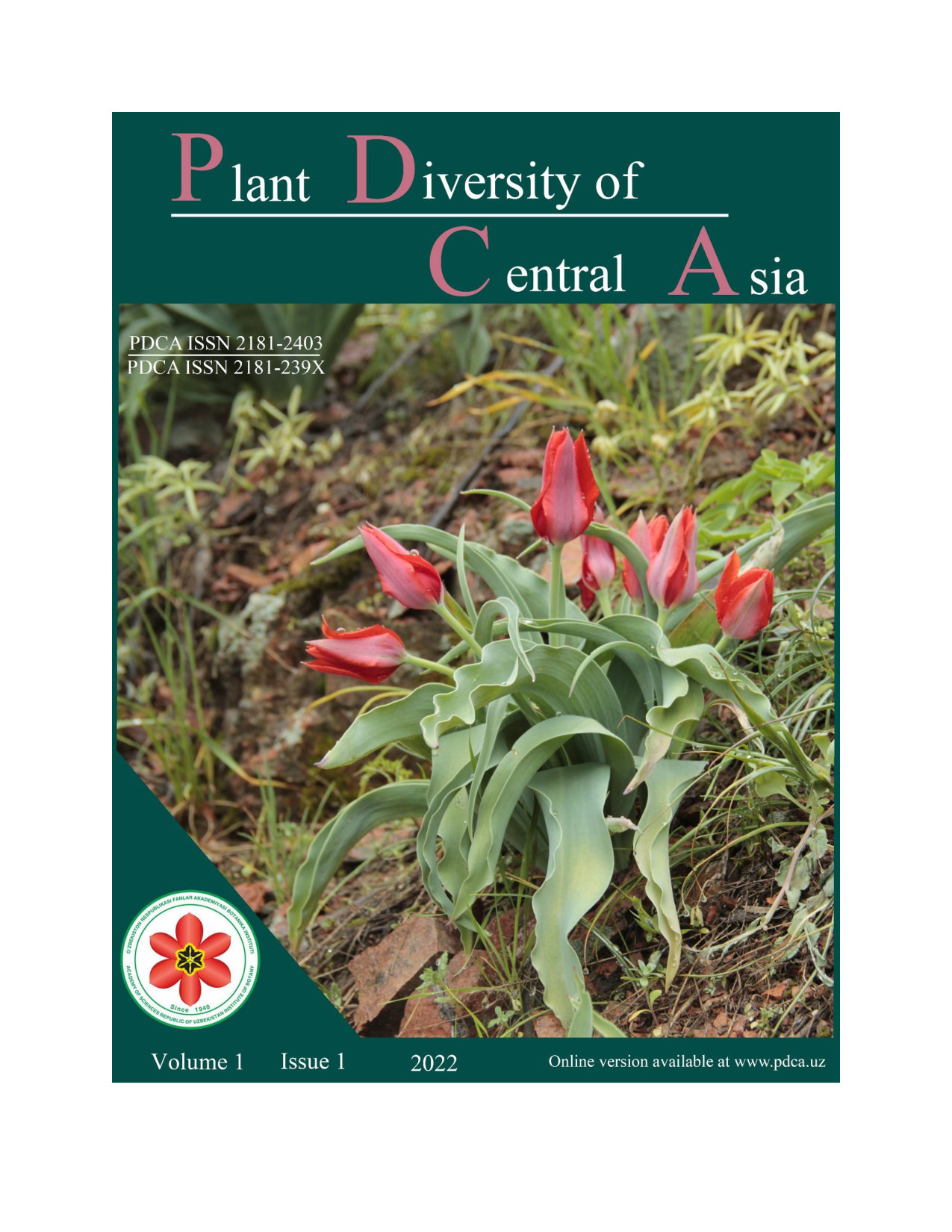
The Tian Shan and Pamir-Alay mountains of Central Asia are generally regarded as the primary center of diversity of Tulipa species, but a comparative morphological description of Central Asian Tulipa species is still lacking. To fill the existing gap, we studied 48 Tulipa species found in Central Asia plus one outgroup (Erythronium caucasicum) for 24 morphological characters of bulbs, leaves, stems and flowers. The obtained data matrix was subjected to a cladistic analysis. Although bootstrap values were low, the morphology-based tree more or less corresponded to previous classifications, except for the placement of sect. Clusianae and T. butkovii.
Share
Скачивания
Библиографические ссылки
Baker J (1874) Revision of the genera and species of Tulipeae. Botanical journal of the Linnean Society 14: 211-310.
Boissier E (1882) Flora orientalis 5, In: Georg H (ed). Geneva & Basle, pp. 191–201.
Botschantzeva Z (1962) Tulips. Taxonomy, morphology, cytology, phytogeography and physiology (Russian edn). English translation: Varekamp H (1982) Balkema, Rotterdam.
Christenhusz M, Govaerts R, David J, Hall T, Borland K, Roberts P, Tuomisto A, Buerki S, Chase M, Fay M (2013) Tiptoe through the tulips–cultural history, molecular phylogenetics and classification of Tulipa (Liliaceae). Botanical journal of the Linnean Society 172: 280-328.
De Groot J, Tojibaev K (2020) A new species of Tulipa from the Surxondaryo province of Uzbekistan.
Eker I, Babac M, Koyuncu M (2014) Revision of the genus Tulipa L. (Liliaceae) in Turkey. Phytotaxa 157: 1-112.
Fay M, Borland K, Stranc P, Chase M (2001) Phylogenetics of the genus Tulipa L. (Liliaceae): evidence from five plastid DNA regions. Botany Congress 12–16 August 2001. Albuquerque: Botanical Society of America. Available at: http://2001.botanyconference.org/section12/abstr acts/95.
Felsenstein J (1985) Confidence limits on phylogenies: an approach using the bootstrap. Evolution 39: 783-791.
Hajdari A, Pulaj B, Schmiderer C, Malaj X, Wilson B, Lluga-Rizani K, Mustafa B (2021) A phylogenetic analysis of the wild Tulipa species (Liliaceae) of Kosovo based on plastid and nuclear DNA sequence.
Hall A (1940) The genus Tulipa.
Khaleghi A, Khadivi A, Zonneveld B (2018) Morphological variations among and within species of wild tulip (Tulipa L.) from Iran.
Lazkov G, Umralina A (2015) Endemic and rare plant species of Kyrgyzstan (Atlas). Food and Agriculture Organization of the United Nations, Ankara.
Li J, Price M, Su D, Zhang Z, Yu Y, Xie D, Zhou S, He X, Gao X (2021) Phylogeny and comparative analysis for the plastid genomes of five Tulipa (Liliaceae).
BioMed Research International 3: 110. Plantarium.ru(2021) https://plantariumdigitalexpo.com.
Poljakova T (1958) Development of the male gametophyte in Trifolium pratense. Volume 3. Bulletin of the University of Leningrad, pp 63– 76. [in Russian].
Popov M (1936) Index seminum Horti Botanici Almaatensis Academiae Scientiaruim, Alma-Ata, Kazakstan 3: 9.
Pourkhaloee A, Khosh-Khui M, Arens P, Salehi H, Razi H, Niazi A, Afsharifar A, van Tuyl J (2018) Molecular analysis of genetic diversity, population structure, and phylogeny of wild and cultivated tulips (Tulipa L.) by genic microsatellites.
Regel E (1873) Enumeratio specierum hucusque cognitarum generis Tulipae.
Silina Z (1977) The Genus Tulipa L.: Ornamental herbaceous plants for open plot cultivation in Morphology of tulips USSR. Volume 2.
Swofford D (2002) PAUP*: Phylogenetic analysis using parsimony (*and other methods)
Tojibaev K, Beshko N (2014) Reassessment of diversity and analysis of distribution in Tulipa (Liliaceae) in Uzbekistan.
Tojibaev K, Beshko N, Popov V (2016) Botanicalgeographical regionalization of Uzbekistan. Botanicheskiĭ Zhurnal 101: 1105-1132.
Van Raamsdonk L, De Vries T (1992) Biosystematic studies in Tulipa subgenus Eriostemones.
Van Raamsdonk L, De Vries T (1995) Species relationships and taxonomy in Tulipa subgenus Tulipa (Liliaceae).
Veldkamp J, Zonneveld B (2012) The infrageneric nomenclature of Tulipa (Liliaceae).
Vvedensky A (1935) Tulipa. In: Komarov V, (ed.) Flora of the USSR. Volume 4. Academy of Sciences of the Soviet Union, Leningrad, pp 246280. [in Russian].
Vvedensky A (1941) The genus Tulipa L. In: Flora Uzbekistanica. Volume 1. The Publishing house of the Academy of Sciences UzSSR, Tashkent, pp 502-520. [in Russian].
Vvedensky A, Kovalevskaja S (1971) Tulipa L. In: Vvedensky A, Conspectus Florae Asiae Mediae. Volume 2. Academy of Sciences Press, Tashkent, pp 94-109. WCVP (2021) https://www.kew.org/.
Zonneveld B (2009) The systematic value of nuclear genome size for “all” species of Tulipa L. (Liliaceae). Plant Systematics and Evolution 281: 217-245.
Опубликован
Выпуск
Раздел
Лицензия

Это произведение доступно по лицензии Creative Commons «Attribution» («Атрибуция») 4.0 Всемирная.
Статьи публикуются на условиях лицензии Creative Commons Attribution 4.0 International (CC BY 4.0). Авторские права сохраняются за авторами.