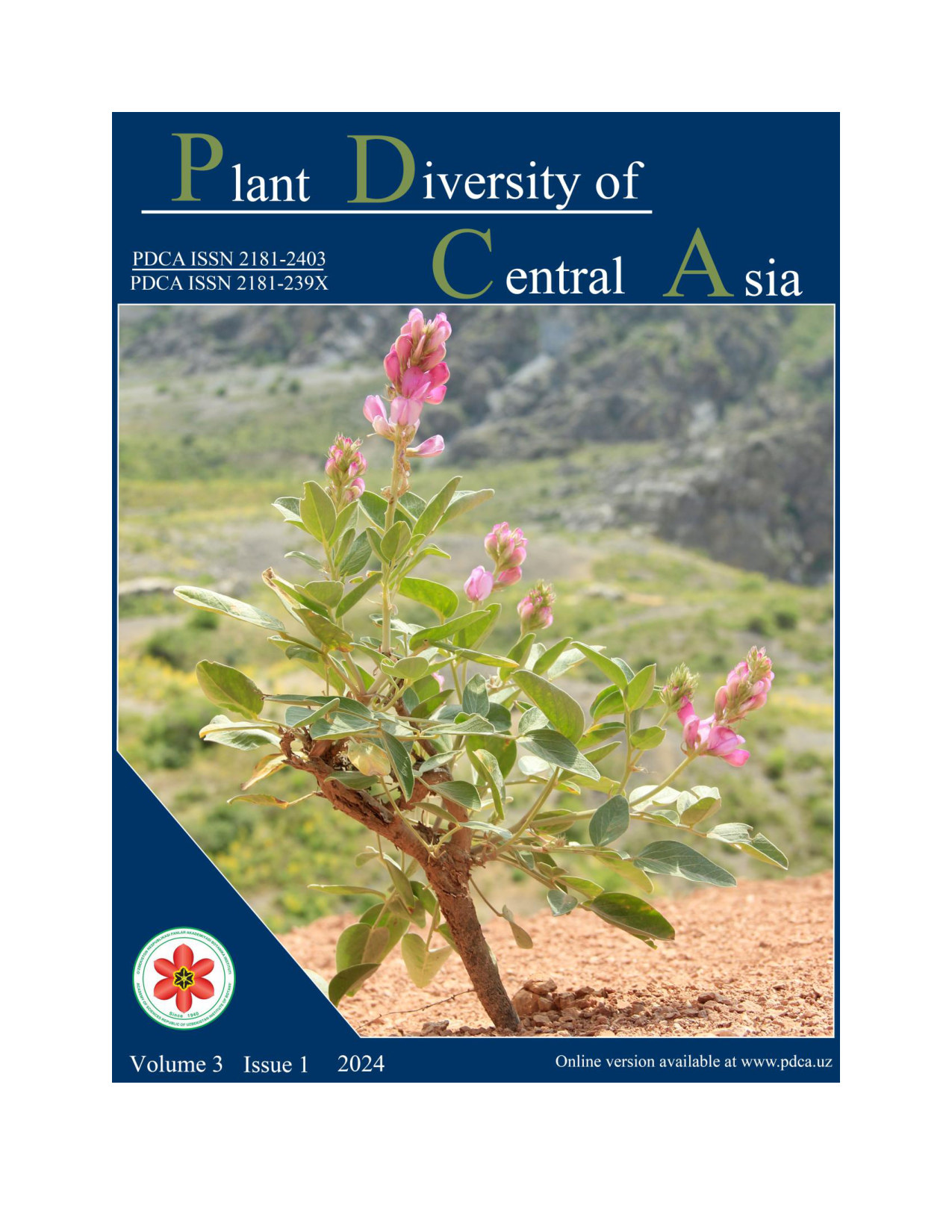
The genus Hedysarum (Fabaceae; Hedysareae) in Uzbekistan
DOI:
https://doi.org/10.54981/PDCA/vol3_iss1/a Check for updates
Kalit so‘zlar:
subsection Crinifera, phylogeny, morphology, character evolution, synapomorphic charactersAbstrak
Uzbekistan is one of the centers of species diversity of Hedysarum (Fabaceae) in Central Asia, where it occurs mainly in the Tian-Shan and Pamir-Alay Mountains. In this study, we reconstructed the phylogenetic relationships of 26 species occurring in Uzbekistan. The species were classified into three clades in both non-monophyletic ITS and monophyletic plastid trees, corresponding to sections Hedysarum (one species) and Stracheya (two species), and subsection Crinifera (23 species) of section Multicaulia. We further assessed the evolutionary status of 22 morphological characters that are used as diagnostic in the taxonomy of Hedysarum. The results showed that the majority of morphological characteristics in Hedysarum exhibit a high level of homoplasy. Only a few of these characteristics, such as pendent flowers in the raceme (section Hedysarum), division of the pod into joints and joint shape and length of pod bristles, serve as synapomorphies for the monophyletic genus and its sections on the plastid tree. Additionally, we propose evaluating additional characters, such as the presence of 1 or 2 pairs of well-developed leaflets of odd-pinnate leaves, long bracts and bracteoles, as apomorphic conditions in some species of subsection Crinifera. This article also presents descriptions, nomenclatural information, type citations, and country-level distribution maps of the species of Hedysarum in Uzbekistan.
Share
Downloads
References
Amirahmadi A, Osaloo SK, Moein F, Kaveh A, Maassoumi AA (2014) Molecular systematics of the tribe Hedysareae (Fabaceae) based on nrDNA ITS and plastid trnL-F and matK sequences. Plant Systematics and Evolution 300(4): 729– 747.
Aytaç Z, Ertuğrul T, Erst A, Fişne A (2022) A new Hedysarum L. species (Fabaceae) from Türkiye, Hedysarum dazkiriense. Phytotaxa 574(4): 273–281.
Baitenov MS (1956) New species of the genus Hedysarum L. Bulletin Acad. Science Kazakh. SSR. 3: 100–105. (in Russian). The genus Hedysarum in Uzbekistan Baitenov MS (1961) Hedysarum L. Flora Kazakhstana. The Academy of Sciences of the Kazakh SSR Press, Alma-Ata, vol. 5: 420–440. (In Russian).
PhD Thesis, Tomsk, Russia Choi BH, Ohashi H (2003) Generic criteria and an infrageneric system for Hedysarum and related genera (Papilionoideae‐Leguminosae). Taxon 52(3): 567–576.
Choi BH, Ohashi H (1996) Pollen morphology and taxonomy of Hedysarum and its related genera of the tribe Hedysareae (Leguminosae-Papilionoideae). Journal of Japanese Botany 71: 191-213.
Dehshiri MM, Goodarzi M (2016) Taxonomic notes on Hedysarum sect. Crinifera (Fabaceae) in Iran, with the description of a new species. In Annales Botanici Fennici. Finnish Zoological and Botanical Publishing Board 53:1–2, 21– 26.
Duan L, Wen J, Yang X, Liu PL, Arslan E, Ertuğrul K, Chang ZY (2015) Phylogeny of Hedysarum and tribe Hedysareae (Leguminosae: Papilionoideae) inferred from sequence data of ITS, matK, trnL‐F and psbA‐trnH. Taxon 64(1): 49–64.
Doyle JJ, Doyle JL (1987) A rapid DNA isolation procedure for small quantities of fresh leaf tissue.
Edgar RC (2004) MUSCLE: multiple sequence alignment with high accuracy and high throughput. Nucleic Acids Research 32(5): 1792–1797.
Fedtschenko BA (1902) The genus Hedysarum. Acta Horti Petrop 19: 185–342. (In Russian)
Fedtschenko BA (1919) Hedysarum olgae p. sp. Botanicheskie Materialy Gerbariya Glavnogo Botanicheskogo Sada R.S.F.S.R 2(1): 1. (In Russian).
Fedtschenko BA (1948) Hedysarum. In: Komarov VL, Shishkin BK, Bobrov EG (eds.), Flora of URSS, vol. 13. Academy of Sciences of the USSR, Moscow & Leningrad, pp. 259–319. (In Russian).
Fedtschenko BA (1949) New species of the genus Hedysarum L. Not. Syst. Herb. Inst. Bot. Komarovii Acad. Sci. URSS, 11: 114–118. (In Russian). Hassanov FO (Ed.) (2019) The Red Data Book of the Republic of Uzbekistan. ‘Chinor ENK’ Press, Tashkent, vol. 1: 62–67. International Plant Names Index. Available online: http://www.ipni.org (Accessed September 15, 2023).
Juramuradov IJ, Byalt VV, Mirzalieva DU, Tojibaev KSh (2022) Type specimens of names of taxa of genus Hedysarum L. (Fabaceae) from Central Asia in the National Herbarium of Uzbekistan (TASH). Vestnik Tomskogo gosudarstvennogo universiteta. Biologiya = Tomsk State University Journal of Biology 57: 6–27.
Juramurodov I, Makhmudjanov D, Yusupov Z, Tojibaev K (2023a) First Comparative Analysis of Complete Chloroplast Genomes Among Six Hedysarum (Fabaceae) Species. Frontiers in Plant Science 14:1211247.
Juramurodov I, Makhmudjanov D, Nikitina E, Liu PL, Yusupov Z, Deng T, Tojibaev K, Sun H (2023b). Phylogenetic relationships and biogeography in Hedysarum L. (Hedysareae, Fabaceae) with a focus on Central Asian taxa. Taxon 72(6): 1262–1284.
Juramurodov I, Tojibaev K, Nikitina E, Makhmudjanov D, Yusupov Z, Deng T, Dehkanov D (2021) Hedysarum sunhangii (Fabaceae, Hedysareae), a new species from Pamir-Alay (Babatag RidgeUzbekistan). Phytotaxa 524(1): 1–13.
Karimova VV (1978) Hedysarum L. In: Ovchinnikov P.N. (ed.), Flora of Tajikistan SSR, 2nd ed., vol. 5. Science Press, Leningrad, pp. 505–527 and 636– 637. (In Russian).
Korotkova EE (1947) New species of the genus Hedysarum L. Not. Syst. Herb. Inst. Bot. et Zool. Acad. Sci. Uzbek, 9: 6–14. (In Russian).
Korotkova EE (1954) New species of the genus Hedysarum L. from Central Asia. Not. The genus Hedysarum in Uzbekistan Syst. Herb. Inst. Bot. et Zool. Acad. Sci. Uzbek 14: 13–16. (In Russian).
Korotkova EE (1955) Hedysarum L. In: Korovin EP, Vvedenskiy AI (eds.), Flora of Uzbekistan, vol. 3. The Academy of Sciences of the Uzbek SSR Press, Tashkent, pp. 723–736. (In Russian).
Kovalevskaya SS (1981) Genus 561 (33) Hedysarum L. In: Vvedenskiy AI, Kamelin RV, Kovalevskaya SS, Nabiev MM (eds.), Conspectus Florae Asiae Mediae. Critical checklist of flora, vol 6. The Uzbek SSR ‘Fan’ Press, Tashkent, pp. 286–311. (In Russian).
Kudryashev SN (1940) New plant species from Pamir-Alai and Hindukush. Not. Syst. Herb. Inst. Bot. et Zool. Acad. Sci. Uzbek 1: 3–6. (In Russian).
Kumar S, Stecher G, Li M, Knyaz C, Tamura K (2018) MEGA X: molecular evolutionary genetics analysis across computing platforms. Molecular Biology and Evolution 35(6): 1547–1549.
Lazkov GA (2008) A new species of the genus Hedysarum (Fabaceae) from Kyrghyzia. Botanical Journal (St. Petersburg) 93(2): 343–346.
Liu PL, Chen XL, Lu Y, Chang ZY, Yue M (2019) New species discovered from old collections, the case of Hedysarum wangii sp. nov. (Fabaceae, Hedysareae). Phytotaxa 413(1): 27–38.
Liu PL, Wen J, Duan L, Arslan E, Ertuðrul K, Chang ZY (2017) Hedysarum L. (Fabaceae: Hedysareae) is not monophyletic – evidence from phylogenetic analyses based on five nuclear and five plastid sequences.
Lock JM (2005) Hedysareae. In: Lewis, G., Schrire, B., Mackinder, B. & Lock, M. (eds.), Legumes of the World. Richmond: Royal Botanic Gardens, Kew, pp. 489– 495.
Maddison WP, Maddison DR (2019) Mesquite: a modular system for evolutionary analysis, Version 3.61. Available at: www.mesquiteproject.org. (Accessed September 15, 2023)
Makhmudjanov D, Juramurodov I, Kurbonaliyeva M, Yusupov Z, Dekhkonov D, Deng T, Tojibaev K, Sun H, (2022) Genus Eremurus (Asphodelaceae) in the flora of Uzbekistan.
Minh BQ, Lanfear R, Trifinopoulos J, Schrempf D, Schmidt HA (2021) IQTREE version 2.1.2: Tutorials and Manual Phylogenomic software by maximum likelihood.
Nafisi HA, Kazempour-Osaloo Sh, Mozaffarian V, Schneeweiss GM (2019) Molecular phylogeny and divergence times of the genus Hedysarum (Fabaceae) with special reference to section Multicaulia in Southwest Asia. Plant Systematics and Evolution 305(10): 1001–1017.
Nafisi HA, Kazempour-Osaloo Sh, Kaveh AK, Mahmoodi MO (2021) A taxonomic revision of the genus Hedysarum L. (Fabaceae-Hedysareae) in Iran. Phytotaxa 511(2):79–110.
Nikitin VV (1949) Genus (33) Hedysarum L. In: Shishkin BK, Nikitin BB (eds.), Flora of Turkmenistan, vol. 4. The Turkmen branch of the academy of sciences of the USSR Press, Ashgabat, pp. 306–312. (In Russian).
Nikitina EV (1957) Genus (29) Hedysarum L. In: Vvedensky AI (ed.), Flora of Kirghiz SSR, vol. 7. The Academy of sciences of the Kyrgyz SSR Press, Frunze, pp. 398– 413. (In Russian).
Podlech D (2012) Checklist of the flowering plants of Afghanistan. München: LudwigMaximilians Universität Press.
Popov MG (1937) New species of Legumes from Central Asia.
POWO Plants of the World Online. (2023) Facilitated by the Royal Botanic Gardens, Kew. Available from: http://www. plantsoftheworldonline.org (Accessed September 15, 2023)
Rambaut A (2012) FigTree v1. 4.0. University of Oxford, Oxford, UK. http://tree.bio.ed.ac.uk/software/figtree The genus Hedysarum in Uzbekistan Ranjbar M, Karamian R, Johartchi MR (2006) Notes on the taxonomy of Hedysarum (Fabaceae) in Iran. Annales Botanici Fennici 43: 152–155.
Ronquist F, Teslenko M, van der Mark P, Ayres DL, Darling A, Höhna S, Larget B, Liu L, Suchard MA, Huelsenbeck JP (2012) MrBayes 3.2: efficient bayesian phylogenetic inference and model choice across a large model space. Systematic biology 61(3): 539–542.
Sang T, Crawford DJ, Stuessy TF (1997) Chloroplast DNA phylogeny, reticulate evolution and biogeography of Paeonia (Paeoniaceae). American Journal of Botany 84(4): 1120–1136.41. Sennikov AN (Ed.) (2016) Flora of Uzbekistan, vol. 1. ‘Navroʻz’ Press, Tashkent, xxviii + 173 pp. (In Russian). Sennikov AN (Ed.) (2017) Flora of Uzbekistan, vol. 2. ‘Navroʻz’ Press, Tashkent, xii + 200 pp. (In Russian). Sennikov AN (Ed.) (2019) Flora of Uzbekistan, vol. 3. ‘Ma’naviat’ Press, Tashkent, xii + 201 pp. (In Russian). Sennikov AN (Ed.) (2022) Flora of Uzbekistan, vol. 4. ‘Fan’ Press, Tashkent, xviii + 238 pp. (In Russian).
Sennikov A, Khassanov F, Ortikov E, Kurbonaliyeva M, Tojibaev KSh (2023) The genus Iris L. sl (Iridaceae) in the Mountains of Central Asia biodiversity hotspot. Plant Diversity of Central Asia 2(1): 1–104.
Sultanova BA (1970) Diagnosis of new species of Hedysarum L. Flora of the Kirghiz SSR. Addition 2, vol. 2. pp. 31–37. (In Latin and Russian).
Sultanova BA (1971) The genus Hedysarum L. in Kyrgyzstan. PhD Thesis, Frunze. (In Russian).
Sultanova BA (1973) Addition to the flora of Kyrgyzstan. Materials on the flora of Kyrgyzstan pp. 43–44. (In Latin and Russian).
Taberlet P, Gielly L, Pautou G, Bouvet J (1991) Universal primers for amplification of three non-coding regions of chloroplast Juramurodov et al. DNA. Plant molecular biology 17(5): 1105–1109.
Tate JA, Simpson BB (2003) Paraphyly of Tarasa (Malvaceae) and diverse origins of the polyploidy species. Systematic Botany 28: 723–737. Thiers B. (continuously updated). Index Herbariorum: A global directory of public herbaria and associated staff. New York Botanical Garden. Available from http://sweetgum.nybg.org/science/ih/. (Accessed September 15, 2023).
Tojibaev K, Beshko N, Turginov O, Mirzalieva D (2014) New records for Fabaceae in the flora of Uzbekistan.
Tojibaev KSh, Beshko NY, Popov VA (2016) Botanical-geographical regionalization of Uzbekistan. Botanicheskiĭ Zhurnal 101(10): 1105–1132.
Tojibaev KSh, Dekhkonov D, Ergashov I, Sun H, Deng T, Yusupov Z (2022) The synopsis of the genus Tulipa (Liliaceae) in Uzbekistan. Phytotaxa 573(2): 163– 214.
Tojibaev KSh, Juramurodov IJ, Sun H (2021) Hedysarum talassicum Nikitina & Sultanova. In Findings to the flora of Russia and adjacent countries: New national and regional vascular plant The genus Hedysarum in Uzbekistan records, 3 (A.V. Verkhozina, ed.). Botanica Pacifica 10(1): 91–92.
Turakulov I, Safarov N, Tojibaev K, Suyunkulov H, Park M, Na N, Usmonov M, Chang KS, Oh SH, Jang CG (2021) The flora of the Western Tian-Shan: Tajikistan part. Journal of Asia-Pacific Biodiversity 14(2): 221–227.
Turdiboev OA, Shormanova AA, Sheludyakova MB, Akbarov F, Drew BT, Celep F (2022) Synopsis of the Central Asian Salvia species with identification key. Phytotaxa 543(1): 1–20.
Vaidya G, Lohman DJ, Meier R (2011) SequenceMatrix: concatenation software for the fast assembly of multi‐gene datasets with character set and codon information. Cladistics 27(2): 171–180.
White TJ, Bruns T, Lee S, Taylor J (1990) Amplification and direct sequencing of fungal ribosomal RNA genes for phylogenetics. In Donald O. Natvig (ed.). PCR protocols: a guide to methods and applications 18(1): 315–322.
Xu LR, Choi BH (2010) Hedysarum L. In: Wu ZY, Raven PH, Hong DY (eds). Flora of China, vol. 10. Beijing: Science Press, St. Louis: Missouri Botanical Garden Press. pp. 514–525. Juramurodov et al. The genus Hedysarum in Uzbekistan Appendix. Voucher information and GenBank accession numbers of species used in this study. New sequences generated in this study are indicated by an asterisk (*). Scientific Collection Name date Hedysarum alaicum 22/05/1916 B.Fedtsch. H. amankutanicum 25.04.1913 B.Fedtsch. H. angrenicum 27/07/1931 Korotkova 30/05/2019 H. baldshuanicum B.Fedtsch. No H. bucharicum B.Fedtsch. 20/05/2019 H. drobovii 11/06/2019 Korotkova H. flavescens Regel 10/08/2019 & Schmalh. H. gypsaceum 23/05/2019 Korotkova 26/05/2019 H. iomuticum B.Fedtsch. H. jaxarticum Popov. H. kudrjaschevii Korotkova H. lehmannianum Bunge H. magnificum Kudr. H. minjanense Rech.f. H. mogianicum B.Fedtsch. 16/06/1953 04/07/1936 06/06/2012 20/05/2019 30/06/1961 13/05/2019 Collection site (in Uzbekistan) Ferghana Province GPS source N. 39.995854 E. 71.790385 Samarkand Province, N. 39.31481 Urgut District E. 66.940661 Tashkent Province, N. 41.20000 Oxongaron District E. 70.3942 Surkhandarya N. 38.622451 Province, Sariosiyo E. 67.580378 District Surkhandarya N. 38.385551 Province, Boysun E. 67.130115 District Tashkent Province, N. 41.560828 Bustonlik District E. 70.106407 Tashkent Province, N. 42.15705 Bustonlik District E. 70.876473 Namangan Province, N. 41.266541 Chartak District E. 71.887084 Surkhandarya N. 38.113833 Province, Uzun E. 68.237942 District Tashkent Province, N. 41.38045 Parkent District E. 69.77491 Kashkadarya N. 38.762901 Province, E. 67.243734 Dekhkanabad District Surkhandarya N. 38.337148 Province, Boysun E. 67.163574 District Surkhandarya N. 38.406537 Province, Boysun E. 67.167624 District Surkhandarya N. 38.531337 Province, Boysun E. 67.359572 District Jizzakh Province, N. 40.519616 Forish District E. 66.750403 Collector Voucher nrDNA ITS number trnL-F matK psbA-trnH Drobov V.P. 1021a OM458868 OM585613 Mikhelson A.I. 1071a OM458870 OM585616 Maskevich A.A. 203a OM458872 OM585617 Juramurodov I.J. Maxmudjanov D.I. 005a OM458843 OM585601 OM898910 OM898878 Juramurodov I.J. 067a OM030218 OM585621 OM898916 OM898898 Juramurodov I.J. 1106a OM030219 OM585622 OM898918 OM898892 OM458845 OM585602 OM898899 OM898879 045-1 OM030221 ON147182 OM898908 Pulatov S.O., Jabborov A.M. 003a OM458847 OM585603 OM898912 Maylun Z. & al. OM458875 OM585618 OM898919 V. Bochantsev OR041883* OR047642* Turginov O.T. 0490-1 OM458851 OM585605 OM898902 OM898883 Juramurodov I.J. 066a OM458849 OM585604 OM898901 OM898882 Pryakhin M.M. OM458874 Juramurodov I.J. 052a OM458853 Tojibaev K.Sh. Juramurodov I.J. Juramurodov I.J. Gulamov R.K. OM898881 OR047643* OM898896 OM585606 OM898913 OM898884 Juramurodov et al. Scientific Name H. montanum 16 (B.Fedtsch.) B.Fedtsch. No The genus Hedysarum in Uzbekistan Collection date 21/06/2019 Collection site (in Uzbekistan) Jizzakh Province, Zaamin District GPS source 05/05/2020 Jizzakh Province, Forish District N. 40.522187 E. 66.763718 11/05/2019 Jizzakh Province, N. 40.522241 Forish District E. 66.763648 Samarkand Province, N. 39.275159 Urgut District E. 66.942306 Jizzakh Province, N. 39.620829 Zaamin District E. 68.393334 N. 39.628815 E. 68.492429 17 H. nuratense Popov 18 H. olgae B.Fedtsch. 15/05/2019 H. plumosum Boiss. 22/06/2019 19 & Hausskn. ex Boiss. H. popovii 14/08/1924 Korotkova H. pskemense 10/08/2019 21 Popov ex B.Fedtsch. H. taschkendicum 08/06/2019 Popov H. turkestanicum 23/05/2019 Regel & Schmalh. H. talassicum 11/08/2019 Nikitina&Sultanova H. santalaschi 01/07/1957 B.Fedtsch. 05/22/2020 H. sunhangii 26 Juramurodov & Tojibaev 27 Onobrychis chorassanica Bunge ex Boiss. 28 Caragana grandiflora DC. 29 Eversmannia subspinosa (Fisch. ex DC.) B.Fedtsch. Namangan Province, Pop District Tashkent Province, Bustonlik District N. 41.31029 E. 70.565617 N. 42.149812 E. 70.87378 Tashkent Province, Parkent District Namangan Province, Yangikurgan District Tashkent Province, Bustonlik District Tashkent Province, Bustonlik District Surkhandarya Province, Uzun District Surkhandarya Province, Uzun District N. 41.380257 E. 69.75585 N. 41.532550 E. 71.706354 N. 42.173586 E. 70.956551 N. 41.40457 E. 70.336868 N. 38.320062 E. 68.225442 – – – – 24/05/2019 Collector Juramurodov I.J. Akbarov F.I., Turdiev D.E., Juramurodov I.J. Voucher nrDNA ITS 051a OM458855 matK psbA-trnH OM585607 OM898903 OM898885 MZ647715 MZ647713 ON147184 OR041881* Juramurodov I.J. Juramurodov I.J. 048a OM030220 OM585623 OM898909 OM898886 Juramurodov I.J. 004a OM458857 OM585608 OM898905 OM898888 Korovin E.P. OR041882* OM585624 OM898890 Tojibaev K.Sh. Juramurodov I.J. OM458861 OM585609 OM898906 OM898891 Juramurodov I.J. OM458863 OM585610 OM898914 OM898893 OM458866 OM585611 OM898915 OM898894 OM458867 OM585612 OM898907 OM898895 1095a OM458876 OM58562 Juramurodov I.J. Gulomov R.K. Tojibaev K.Sh., Juramurodov I.J. Nabiev M.M. Pulatov et al. OR041880* Beshko N.Yu., Makhmudov A. TASH0589 – – – – – – – – – N. 38.328013 E. 68.21836 trnL-F OM898897 MZ647714 MZ647712 ON147183 KP338196 KP338315 KP338573 KP338448 – AB051905 AB287412 AB854564 – KP338144 AB854527 AB854573 KP338394 Juramurodov et al. The genus Hedysarum in Uzbekistan Fig. S1. Maximum likelihood tree inferred from nrDNA ITS sequences. Bootstrap values of maximum likelihood (ML) / maximum parsimony (MP) are given on each branch; Bayesian posterior probability (PP) is below branches. Only bootstrap values >45% are shown. Juramurodov et al. The genus Hedysarum in Uzbekistan Fig. S2. Maximum likelihood tree inferred from combined plastid (trnL-trnF, matK and psbA-trnH) sequences. Bootstrap values of maximum likelihood (ML) / maximum parsimony (MP) are given on each branch; Bayesian posterior probability (PP) is below branches. Only bootstrap values >45% are shown.
Nashr qilingan
Nashr
Bo'lim
License

This work is licensed under a Creative Commons Attribution 4.0 International License.
Maqolalar Creative Commons Attribution 4.0 International (CC BY 4.0) litsenziyasi asosida nashr etiladi. Mualliflik huquqi mualliflarda saqlanadi.