Phylogenomics and biogeographic patterns of Scutellaria L. (Lamiaceae): southern Asian origins and worldwide dispersal
DOI:
https://doi.org/10.54981/PDCA/vol4_iss2/a2 Check for updates
Kalit so‘zlar:
plastome structure, comparative genomics, codon usage bias, hypervariable regions, lineage diversification, evolutionary historyAbstrak
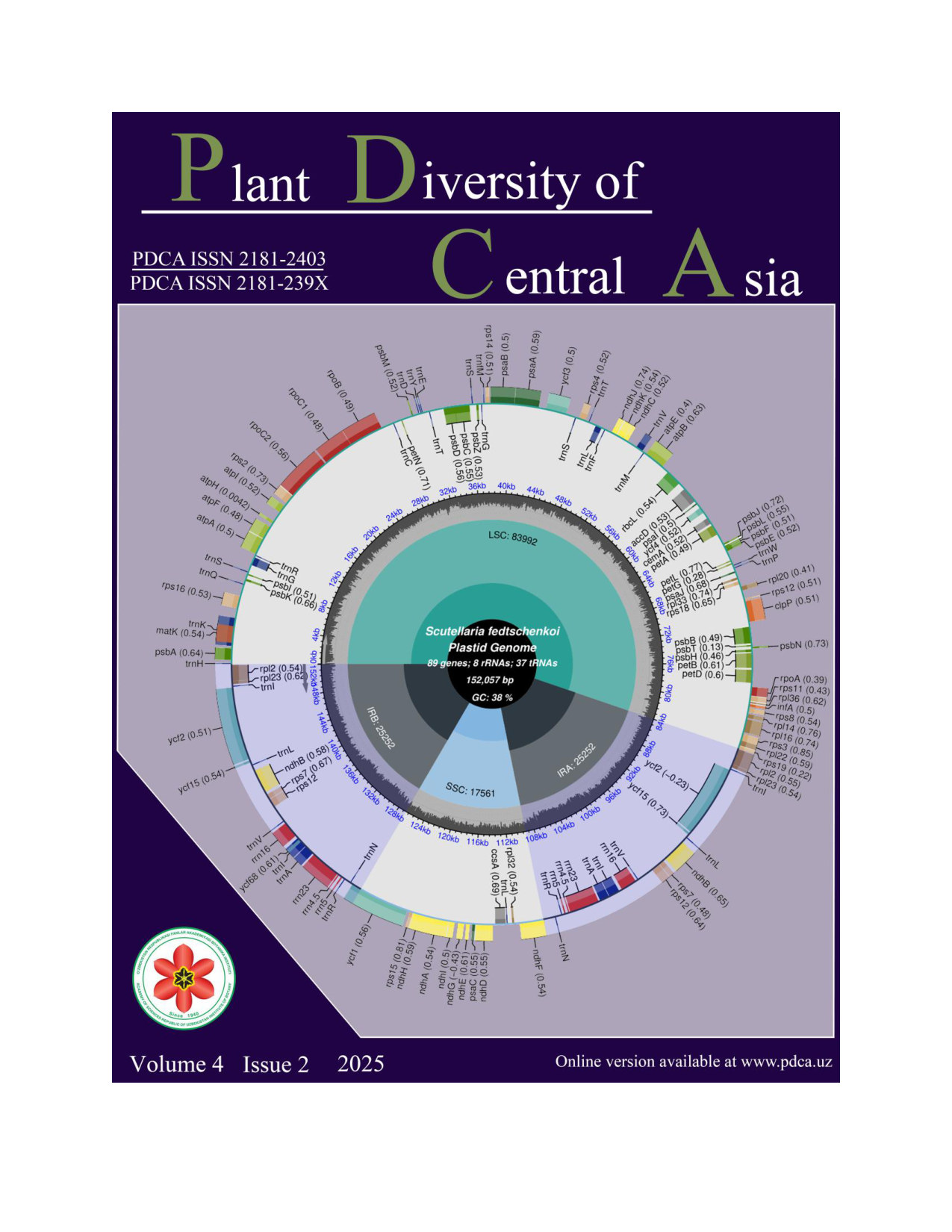
Scutellaria L. (Lamiaceae) is a diverse and pharmacologically important genus with significant species richness in Central Asia. Here, we sequenced and analyzed complete chloroplast genomes of 14 Scutellaria species from Uzbekistan and adjacent regions, integrating them with 184 publicly available plastomes to investigate genome evolution, phylogenetic relationships, and biogeographic history. All plastomes exhibited a conserved quadripartite structure, with limited variation in genome size (151.6– 152.3 kb), GC content (38.23–38.34%), and gene content. Codon usage showed a consistent bias toward A/T-ending codons. A total of 32–55 SSRs were identified per genome, with elevated variability in several Central Asian taxa, highlighting their utility as molecular markers. Nucleotide diversity analyses revealed highly variable loci, primarily in noncoding regions, suitable for DNA barcoding and phylogenetic inference. Phylogenomic reconstruction strongly supported the monophyly of Scutellaria and resolved three major evolutionary lineages. Newly sequenced taxa provided strong support for the cohesion of the Anaspis lineage, reinforcing its recognition at the subgeneric level. Ancestral area analyses indicate a southern Asian origin followed by diversification in Central and Eastern Asia and multiple dispersal events into Europe, Africa, and the Americas.
Share
Downloads
References
Abdullah, Yan, R., & Tian, X. (2025). CGAS (Chloroplast genome analysis Suite): an automated python pipeline for comprehensive comparative Chloroplast genomics. iMetaOmics, e70093. https://doi.org/10.1002/imo2.70093
Bobur, K., Jorabek, T., Sarviniso, M., & Ziyoviddin, Y. (2025). First complete chloroplast genome of Thymus seravschanicus: Insights into genome structure and phylogenetic relationships within Lamiaceae. Journal of Asia-Pacific Biodiversity, 18(1), 185-189. https://doi.org/10.1016/j.japb.2024.09.001
Chen, S., Zhou, Y., Chen, Y., & Gu, J. (2018). fastp: An ultra-fast all-in-one FASTQ preprocessor. Bioinformatics, 34(17), i884– i890. https://doi.org/10.1093/bioinformatics/bty56 Phylogenomics and biogeography of Scutellaria Cock, P.
J. A., et al. (2009). Biopython: Python tools for computational biology. Bioinformatics, 25(11), 1422–1423. https://doi.org/10.1093/bioinformatics/btp16
Georgieva, Y., Katsarova, M., Stoyanov, P., Mladenov, R., Denev, P., Teneva, D., ... & Dimitrova, S. (2020). Metabolite profile and antioxidant activity of some species of Genus Scutellaria growing in Bulgaria. Plants, 10(1), 45. https://doi.org/10.3390/plants10010045
Jiang, D., Zhao, Z., Zhang, T., Zhong, W., Liu, C., Yuan, Q., & Huang, L. (2017). The chloroplast genome sequence of Scutellaria baicalensis provides insight into intraspecific and interspecific chloroplast genome diversity in Scutellaria. Genes, 8(9), 227. https://doi.org/10.3390/genes8090227
W., Yi, T. S., & Li, D. Z. (2020). GetOrganelle: A fast and versatile toolkit for accurate de novo assembly of organelle genomes. Genome Biology, 21, 241. https://doi.org/10.1186/s13059-02002154-5
I., Turginov, O., Naralieva, N., Azimova, D., ... & Yusupov, Z. (2024). Analysis of chloroplast genomes of ten central Asian Fritillaria species and their phylogenetic relationships. Nordic Journal of Botany, 2024(12), e04413. https://doi.org/10.1111/njb.04413
Karimov, B. (2026) «Supplementary Materials for: Phylogenomics and biogeographic history of Scutellaria reveal a southern Asian origin and global dispersal patterns», Plant Diversity of Central Asia. Zenodo. https://doi.org/10.5281/zenodo.19494253
Katoh, K., & Standley, D. M. (2013). MAFFT multiple sequence alignment software version 7. Molecular Biology and Evolution, 30(4), 772–780. https://doi.org/10.1093/molbev/mst010
Kearse, M., Moir, R., Wilson, A., Stones-Havas, S., Cheung, M., Sturrock, S., et al. (2012). Karimov et al. Geneious Basic: An integrated and extendable desktop software platform for the organization and analysis of sequence data. Bioinformatics, 28(12), 1647–1649. https://doi.org/10.1093/bioinformatics/bts19
Letunic, I., & Bork, P. (2021). Interactive Tree Of Life (iTOL) v6: An online tool for phylogenetic tree display and annotation. Nucleic Acids Research, 49(W1), W293– W296. https://doi.org/10.1093/nar/gkab301
L., Ma, Z. H., ... & Zhang, D. X. (2016). A large-scale chloroplast phylogeny of the Lamiaceae sheds new light on its subfamilial classification. Scientific reports, 6(1), 34343. https://doi.org/10.1038/srep34343
X., Ohi-Toma, T., Lee, J., Hsieh, T. H., ... & Qiu, Y. X. (2017). Molecular phylogenetics and biogeography of the mint tribe Elsholtzieae (Nepetoideae, Lamiaceae), with an emphasis on its diversification in East Asia. Scientific Reports, 7(1), 2057. https://doi.org/10.1038/s41598-017-02157-6
T., Schmidt, H. A., von Haeseler, A., & Minh, B. Q. (2015). IQ-TREE: A fast and effective stochastic algorithm. Molecular Biology and Evolution, 32(1), 268–274. https://doi.org/10.1093/molbev/msu300
Nikitina, E., Karimov, B., & Tojiboeva, U. (2025). Complete chloroplast genome of the medicinally important plant Ajuga turkestanica (Regel) Briq.(Lamiaceae) from Uzbekistan. Journal of Asia-Pacific Biodiversity. https://doi.org/10.1016/j.japb.2025.07.003
Niu, Y., Qin, Q., Dong, Y., Wang, X., Zhang, S., & Mu, Z. (2023). Chloroplast genome structure and phylogenetic analysis of 13 Lamiaceae plants in Tibet. Frontiers in Bioscience-Landmark, 28(6), 110. https://doi.org/10.31083/j.fbl2806110
Paton A (1990a) A global taxonomic investigation of Scutellaria L.
Kew Bull 45:399–450. https ://doi.org/10.2307/41105 Phylogenomics and biogeography of Scutellaria Paton A (1990b) The phylogeography of Scutellaria L.
Paton A, Suddee S, Bongcheewin B (2016) Two new species of Scutellaria (Lamiaceae) from Thailand and Burma.
Paton AJ (1989). A global taxonomic investigation of Scutellaria L. and its allies (Labiatae). Phd thesis, University of Edinburgh Qu, X.
J., Li, D. Z., & Yi, T. S. (2019). PGA: A software package for rapid, accurate, and flexible batch annotation of plastomes. Bioinformatics, 35(21), 4510– 4512. https://doi.org/10.1093/bioinformatics/btz32
N., Zamfirache, M. M., & Ivănescu, L. C. (2024). Comparative analysis of seed morphology in genus Scutellaria L. Notulae Botanicae Horti Agrobotanici Cluj-Napoca, 52(3). https://doi.org/10.15835/nbha52314088
Safikhani, K., Jamzad, Z., & Saeidi, H. (2018). Phylogenetic relationships in Iranian Scutellaria (Lamiaceae) based on nuclear ribosomal ITS and chloroplast trn LF DNA data. Plant Systematics and Evolution, 304(9), 1077-1089. https://doi.org/10.1007/s00606-018-1533-0
A., Parolly, G., & Borsch, T. (2021). Overall phylogenetic relationships of Scutellaria (Lamiaceae) shed light on the origin of the predominantly Caucasian and Irano-Turanian S. orientalis group. Willdenowia, 51(3), 395-427. https://doi.org/10.3372/wi.51.51307
Shan, Y., Pei, X., Yong, S., Li, J., Qin, Q., Zeng, S., & Yu, J. (2021). Analysis of the complete chloroplast genomes of Scutellaria tsinyunensis and Scutellaria tuberifera (Lamiaceae). Mitochondrial DNA Part B, 6(9), 2672-2680. https://doi.org/10.1080/23802359.2021.1920 Karimov et al. Phylogenomics and biogeography of Scutellaria Shen, J., Li, P., Liu, S., Liu, Q., Li, Y., Sun, Y., ... & Xiao, P. (2021). Traditional uses, tenyears research progress on phytochemistry and pharmacology, and clinical studies of the genus Scutellaria. Journal of Ethnopharmacology, 265, 113198. https://doi.org/10.1016/j.jep.2020.113198
L., Kusuma, G., & Parani, M. (2015). DNA barcoding for species identification from dried and powdered plant parts: a case study with authentication of the raw drug market samples of Sida cordifolia. Gene, 559(1), 86-93. https://doi.org/10.1016/j.gene.2015.01.025
Wang, Y., Xu, C., Guo, X., Wang, Y., Chen, Y., Shen, J., ... & Wang, Q. (2024). Phylogenomics analysis of Scutellaria (Lamiaceae) of the world. BMC biology, 22(1), 185. https://doi.org/10.1186/s12915-024-01982-2
J., Blair, C., & He, X. (2015). RASP (Reconstruct Ancestral State in Phylogenies): a tool for historical biogeography. Molecular phylogenetics and evolution, 87, 46-49. https://doi.org/10.1016/j.ympev.2015.03.008
P., Wang, Q., Yu, W. B., ... & Xiang, C. L. (2020). Leveraging plastomes for comparative analysis and phylogenomic inference within Scutellarioideae (Lamiaceae). PloS one, 15(5), e0232602. https://doi.org/10.1371/journal.pone.023260
D., Peng, H., & Xiang, C. L. (2017). A new species of Scutellaria (Scutellarioideae, Lamiaceae) from Sichuan Province in southwest China. PeerJ, 5, e3624. https://doi.org/10.7717/peerj.3624
Zheng S, Poczai P, Hyvönen J, Tang J and Amiryousefi A (2020) Chloroplot: An Online Program for the Versatile Plotting of Organelle Genomes. Front. Genet. 11:576124 https://doi.org/10.3389/fgene.2020.576124 Karimov et al. Phylogenomics and biogeography of Scutellaria Figure S1. Maximum likelihood phylogenetic tree of Scutellaria and related taxa of Lamiaceae based on complete plastome sequences and NCBI GenBank accession numbers. Newly sequenced species are given in red. Karimov et al. Phylogenomics and biogeography of Scutellaria Figure S2. RASP ancestral area reconstruction of Scutellaria based on plastome phylogeny, showing inferred ancestral distributions,
Nashr qilingan
Nashr
Bo'lim
License

This work is licensed under a Creative Commons Attribution 4.0 International License.
Maqolalar Creative Commons Attribution 4.0 International (CC BY 4.0) litsenziyasi asosida nashr etiladi. Mualliflik huquqi mualliflarda saqlanadi.